






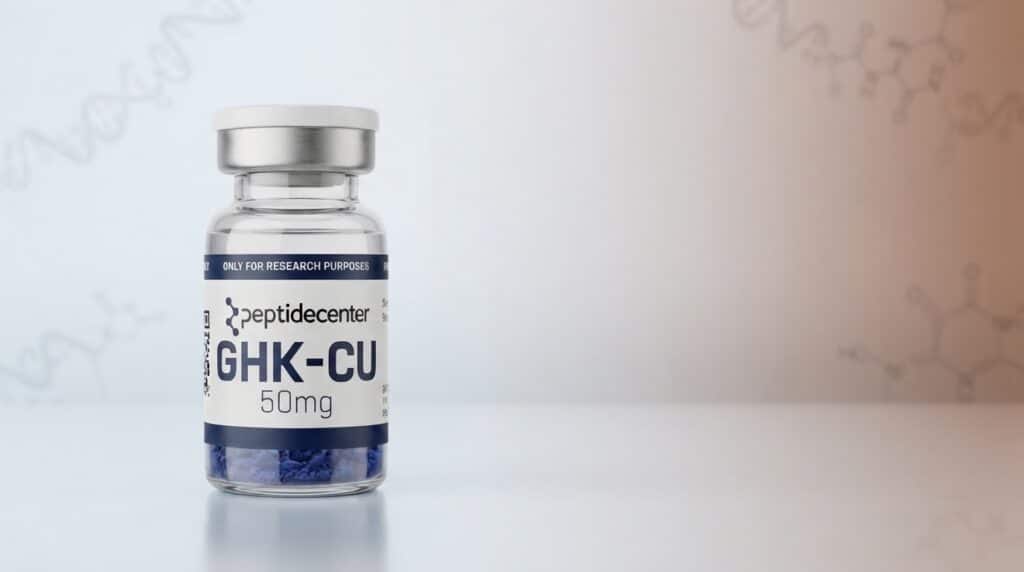
GHK-Cu is one of the most researched copper peptides in cosmetic dermatology. While many ingredients have only received attention in recent years, GHK-Cu has a research history of more than fifty years: it was discovered as early as 1973. Since then, it has been studied in relation to collagen production, wound healing, skin rejuvenation, and gene expression.
In this article, you will read exactly what GHK-Cu is, how it works according to research, what the key studies show, and how it compares to other well-known skin ingredients. We also discuss the different forms — from serum to powder — and what the literature says about safety.
Important: GHK-Cu is offered by PeptideCenter exclusively for research purposes. All information in this article is intended for educational and scientific purposes and is not an instruction for use or medical advice. PeptideCenter makes no statements regarding efficacy, safety, or suitability for use in humans or animals.
What is GHK-Cu?
GHK-Cu, also written as GHK CU or ghkcu, is a copper-bound peptide. It consists of three amino acids—glycine, histidine, and lysine—which together form the tripeptide GHK. This chain binds a copper ion (Cu²⁺), forming the GHK-Cu complex: a copper peptide.
The compound was discovered in 1973 by biochemist Loren Pickart, who isolated it from human blood plasma. Pickart noticed that plasma from younger donors made older liver tissue behave “younger” in laboratory experiments. The active ingredient turned out to be the small tripeptide GHK. When the strong affinity for copper was discovered later, the form being studied today emerged.
An important fact: the natural concentration of GHK in the body decreases with age. The literature describes that the plasma concentration is approximately 200 ng/mL around the age of twenty and has dropped to about 80 ng/mL by the age of sixty — a decrease of more than 60%. This decline roughly coincides with the slowdown in collagen production and skin repair that many people notice starting in their thirties and forties. It is one of the reasons why GHK-Cu receives so much attention in anti-aging research.
GHK-Cu as copper peptide
Within the broader group of copper peptides, GHK-Cu is the best-known and most studied example. Copper peptides is the collective name for peptides bound to copper; GHK-Cu is the specific compound that is central to the majority of studies.
What makes GHK-Cu special within this group is the role of the copper ion. Copper is an essential trace element involved in copper-dependent enzymes such as lysyl oxidase and superoxide dismutase—enzymes that play a role in collagen crosslinking and protection against oxidative stress, respectively. Because GHK-Cu carries and releases copper in a controlled manner, it is being studied as a carrier within these processes.
How does GHK-Cu work?
The action of GHK-Cu has been described in the literature as that of a signaling molecule: Pickart described it as a “biological signal of tissue damage”. The research points to several parallel mechanisms.
Collagen and matrix production. In a widely cited study by Maquart, Pickart, and colleagues (FEBS Letters, 1988), GHK-Cu stimulated collagen synthesis in cultured fibroblasts at very low concentrations, with a peak effect around 10⁻⁹ M. Later studies also described an increase in glycosaminoglycans and proteoglycans such as dermatan sulfate.
Regulation of degradation enzymes. Research has linked GHK-Cu to the modulation of matrix metalloproteinases (MMPs) and their inhibitors (TIMPs) — the enzymes that regulate skin tissue breakdown. The research suggests that GHK-Cu influences both buildup and controlled breakdown.
Gene expression. One of the most striking findings comes from gene analysis. In the review article by Pickart and Margolina (International Journal of Molecular Sciences, 2018), based on Broad Institute data, it is described that GHK-Cu influences the expression of a significant proportion of human genes — in some analyses up to over 30% at a threshold of ≥50% change. Much of this work is preclinical, but it explains the broad scientific interest.
It is important to emphasize that a large part of this research has been conducted in the laboratory or in cell models. Results from such studies cannot be directly translated into practical or personal application.
What does the clinical research say?
Unlike many cosmetic ingredients, there is a series of placebo-controlled studies in humans for GHK-Cu. They are typically small and short-term — characteristic of cosmetic research — but the results consistently point in the same direction.
- Leyden et al. (2005, Dermatologic Surgery). A twelve-week randomized study in women aged 50 to 59 with photoaging. Twice-daily topical GHK-Cu was associated with improvements in firmness, elasticity, clarity, and the depth of fine lines.
- Badenhorst et al. (2016). Investigated the effect of GHK-Cu on MMP and TIMP expression, collagen and elastin production, and wrinkle parameters. In this study, a significant reduction in wrinkle volume was reported.
- Carey/Pickart ultrasound examination. Structural study in which an average increase in collagen density of approximately 28% was observed after twelve weeks, with higher outliers.
- Abdulghani et al. (1999). A comparative study in which topical GHK-Cu showed an increase in collagen in a subset of the participants.
These figures are derived from specific studies under specific conditions. They are not a commitment to a result; they describe what was observed in that study. As several reviews note, there is no large multicenter RCT for GHK-Cu — the biology is plausible and the evidence supportive, but not definitive.
GHK-Cu compared to other skin ingredients
To put GHK-Cu in perspective, below is a comparison with two well-known ingredients that often serve as references in cosmetic research.
| Characteristic | GHK-Cu | Retinol / retinoids | Vitamin C |
|---|---|---|---|
| Type | Copper peptide (signaling molecule) | Vitamin A derivative | Antioxidant |
| Main research focus | Collagen, matrix repair, gene expression | Cell renewal, collagen | Antioxidation, collagen cofactor |
| Works at low concentration | Yes (nanomolar in studies) | No | No |
| Potential for irritation | Low in research | Can be high | Moderate |
| Research basis | ~50 years, many small/preclinical | Extensive, large trials | Extensive |
| Effect size (skin) | Measurable, usually moderate | Often stronger in head-to-head | Moderate |
What stands out in the literature: GHK-Cu is often described as well tolerated and effective at very low concentrations, but with effect sizes that generally lag behind retinoids in direct comparisons. The distinguishing feature lies less in potency and more in the broad, regulatory character and low irritation.
GHK-Cu and the skin
The majority of research into GHK-Cu focuses on the skin. The compound is being studied in relation to skin rejuvenation, collagen production, and the restoration of the skin barrier. Cosmetic research has examined firmness, fine lines, and the overall condition of the skin.
An interesting and frequently cited finding from the research: with GHK-Cu, “more is better” does not hold true. Studies indicate that the compound works optimally at low concentrations, because at higher concentrations, collagen-degrading enzymes are also more strongly activated. The research thus seeks a balance between synthesis and breakdown.
GHK-Cu and her
In addition to the skin, hair features frequently in GHK-Cu research. The compound is being studied in relation to the hair follicle and the conditions that influence hair condition, including blood flow around the follicle and the production of supporting proteins. This is a research area that is still very much in development. GHK-Cu is one of the few compounds that appears in both skin- and hair-focused research.
Forms: serum, powder and topical application
GHK-Cu occurs in various forms. The most commonly mentioned in a cosmetic context is the Serum GHK-Cu: a liquid, topical formulation in which the peptide is already dissolved. Additionally, GHK-Cu is being studied in creams and other topical formulations, and sometimes combined with ingredients such as low-molecular-weight hyaluronic acid.
At PeptideCenter, GHK-Cu is currently offered as freeze-dried powder (lyophilisate) for research purposes. A powder and a serum differ fundamentally: the powder is first reconstituted within a research context, whereas a serum is a ready-to-use formulation. A ready-to-use GHK-Cu serum is under development at PeptideCenter and is expected to be added to the range later this year. Keep the GHK-Cu product page Keep an eye out for current availability.
Dissolve and store GHK-Cu
GHK-Cu in powder form is dissolved in bacteriostatic water. The method of dissolution and storage largely determines how stable the peptide remains. In short: store freeze-dried powder in a dark, dry, and cool place at 2–8°C. For longer storage, -20°C is suitable. Store a dissolved solution refrigerated and process it within 28 days according to protocol.
You can find a comprehensive, step-by-step explanation in our reconstitution and storage guide, including the most common mistakes and how to avoid them.
Side effects and safety
In the 2018 review article, GHK-Cu is described as a compound with a long history of use in wound healing and skin research, which occurs naturally and is active in studies at very low concentrations. Reactions reported in cosmetic research are typically mild and rare, such as slight redness or irritation — often attributed to constituents of a formulation rather than GHK-Cu itself.
Because GHK-Cu is offered by PeptideCenter exclusively for research purposes, PeptideCenter makes no statements regarding safety, side effects, or suitability for personal use. For reliable and up-to-date information, the scientific literature is the designated source. Anyone using GHK-Cu in a research context must adhere to applicable laboratory protocols and local regulations.
Frequently asked questions about GHK-Cu
What does GHK-Cu mean?
GHK-Cu stands for the tripeptide glycine-histidine-lysine (GHK), bound to a copper ion (Cu). Together, they form a copper peptide that occurs naturally in the human body.
What is the difference between GHK-Cu and copper peptides?
Copper peptides is the collective name for all peptides bound to copper. GHK-Cu is the best-known and most researched example of this.
What is a GHK-Cu serum?
A GHK-Cu serum is a liquid, topical formulation in which the peptide is already dissolved. It differs from the freeze-dried powder submitted for research, which is first reconstituted.
Why does GHK-Cu decrease with age?
The natural concentration of GHK in the body decreases as we age — described in the literature from approximately 200 ng/mL around the age of twenty to approximately 80 ng/mL around the age of sixty. This is one of the reasons why the compound receives much attention in anti-aging research.
How does GHK-Cu compare to retinol?
Both are being studied in research in relation to collagen. GHK-Cu works at very low concentrations in studies and is described as well tolerated, whereas retinoids often show a stronger effect in direct comparisons, with a higher risk of irritation.
In what forms is GHK-Cu available?
GHK-Cu is being studied and offered as a freeze-dried powder, as a serum, and as a topical formulation in creams, among other forms. At PeptideCenter, it is currently available as a powder; a serum is under development.
Is GHK-Cu suitable for personal use?
No. GHK-Cu is offered exclusively for research purposes and laboratory testing, not for use in humans or animals.
More about GHK-Cu
GHK-Cu is available as freeze-dried powder in the category Skin, hair & cosmeticView the GHK-Cu product page for specifications, purity and available variants, or read more in our knowledge base.
Sources and further reading:
- Pickart L., Margolina A. Regenerative and Protective Actions of the GHK-Cu Peptide in the Light of the New Gene Data. Int J Mol Sci. 2018;19(7):1987.
- Maquart F.X., Pickart L., Laurent M., et al. Stimulation of collagen synthesis in fibroblast cultures by the tripeptide-copper complex glycyl-L-histidyl-L-lysine-Cu2+. FEBS Lett. 1988;238(2):343-346.
- Leyden JJ, et al. Anti-aging benefits of a GHK-Cu facial and eye cream: a randomized 12-week clinical trial. Dermatol Surg. 2005;31(7):809-816.
- Badenhorst T., et al. Effects of GHK-Cu on MMP and TIMP expression, collagen and elastin production, and facial wrinkle parameters. J Aging Sci. 2016;4(3).
- Pickart L., et al. GHK Peptide as a Natural Modulator of Multiple Cellular Pathways in Skin Regeneration. BioMed Res Int. 2015.
Delve deeper into GHK-Cu and copper peptides
View product specifications, batch information, and related knowledge articles regarding GHK-Cu and other research peptides.