


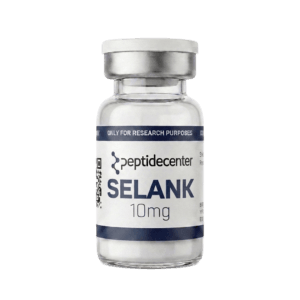
 From this articleSelankCognition & focus · €14.25 – €19.45
 From this articleSemax + SelankCognition & focus · €38.95
Selank and Semax are often mentioned in the same breath. Both are synthetic heptapeptides — chains of exactly seven amino acids — and both are classed as nootropics within research. Chemically, however, they are two completely different molecules, with a different origin and a different research direction.
In this article we place them side by side: what they are exactly, where their sequence comes from, how their activity profile differs in the literature, and why researchers sometimes look at them in combination.
Selank and Semax in brief
The quickest way to see the difference is to place the molecular basis side by side. All values below come from PubChem, the chemical database of the American National Center for Biotechnology Information.
| Characteristic | Semax | Selank |
|---|---|---|
| Type molecuul | Synthetic heptapeptide | Synthetic heptapeptide |
| Amino acid sequence | Met-Glu-His-Phe-Pro-Gly-Pro | Thr-Lys-Pro-Arg-Pro-Gly-Pro |
| Derived from | ACTH(4-7) fragment | Tuftsin (Thr-Lys-Pro-Arg) |
| Molecular formula | C37H51N9O10S | C33H57N11O9 |
| Molecuulmassa | 813.9 g/mol | 751.9 g/mol |
| CAS number | 80714-61-0 | 129954-34-3 |
| PubChem CID | 9811102 | 11765600 |
| Shared structural element | C-terminal Pro-Gly-Pro | C-terminal Pro-Gly-Pro |
| Research focuses on | Neurotrophic factors, monoamine systems | GABA signalling, anxiety response |
What stands out immediately: the two sequences share not a single amino acid in the first four positions, yet both end in the same tail. Later in this article we explain why that is. You will find both peptides in our category Cognition & Focus.
What is Semax?
Semax is a synthetic heptapeptide with the sequence Met-Glu-His-Phe-Pro-Gly-Pro, abbreviated as MEHFPGP in single-letter notation. At 813.9 g/mol the molecule is the heavier of the two, and the only one of the two that contains sulphur — that comes from the methionine (Met) the chain starts with.
Where the sequence comes from
The first four amino acids of Semax — Met-Glu-His-Phe — are identical to positions 4 to 7 of adrenocorticotropic hormone (ACTH), one of the body’s own hormones of 39 amino acids. PubChem accordingly lists Semax under the synonym “ACTH (4-7), Pro-Gly-Pro-”. In older literature Semax is often described as an analogue of the ACTH(4-10) fragment, because that longer fragment was the starting point of the research field Semax came out of.
Important to understand: Semax contains only this short fragment, not the complete hormone. A tail of three amino acids has been added to that fragment — Pro-Gly-Pro — which does not occur in that position in the original ACTH molecule.
What research into Semax focuses on
The published research into Semax is largely preclinical and clusters around two themes. The first is the expression of neurotrophic factors: proteins that play a role in the maintenance and formation of nerve cells. A study in Doklady Biological Sciences (2003) examined the influence of Semax on the expression of BDNF in various brain regions of rats, and later work looked at the regulation of BDNF and the associated trkB receptor in the rat hippocampus.
The second theme is the involvement of monoamine systems. Research in rodents has looked at the influence of Semax on dopaminergic and serotonergic signalling pathways. These are the systems that neuroscience generally associates with attention, motivation and mood regulation — which explains why Semax is usually examined in the context of cognitive themes within research.
What is Selank?
Selank is likewise a synthetic heptapeptide, with the sequence Thr-Lys-Pro-Arg-Pro-Gly-Pro. In the literature you will also come across it under the code name TP-7. At 751.9 g/mol the molecule is slightly lighter than Semax, and it contains no sulphur but strikingly much nitrogen — eleven atoms, against nine for Semax.
Where the sequence comes from
The first four amino acids of Selank — Thr-Lys-Pro-Arg — together form tuftsin, a naturally occurring tetrapeptide that has been described as an immunologically active peptide since the 1970s. In the literature Selank was therefore introduced as a synthetic analogue of tuftsin.
The pattern is therefore exactly the same as with Semax: an existing, shorter fragment from nature, extended with the same Pro-Gly-Pro tail. Only the starting fragment differs — and that is precisely why the two molecules have such a different research profile.
What research into Selank focuses on
Where Semax research looks at neurotrophic factors, Selank research largely revolves around GABA signalling. GABA is the main inhibitory neurotransmitter in the central nervous system. A review in Protein and Peptide Letters (2018) describes, on the basis of radioligand receptor analysis, that Selank influences GABA binding as a positive allosteric modulator, with binding sites that may overlap with — but are not identical to — those of benzodiazepines.
A second line of research looks at enkephalin-degrading enzymes, and a third at how Selank behaves alongside existing substances: animal model research has been published in which Selank was examined together with diazepam under chronic stress conditions. The common thread in almost all of this work is the anxiety and stress response, not cognition in the sense of memory or learning ability.
The difference in activity profile
Place the two research fields side by side and a clear contrast emerges. It is the difference between an activating and a dampening profile — although that is a simplification of a literature that consists mainly of animal models.
| Semax | Selank | |
|---|---|---|
| Starting fragment | Hormone fragment (ACTH) | Immune peptide (tuftsin) |
| Best-studied route | Neurotrophic factors, monoamines | GABA system |
| Research themes | Attention, memory, mental performance | Anxiety response, stress resilience |
| Roughly characterised as | Activating profile | Calming profile |
That contrast is no coincidence. The two molecules may share their length and their tail, but their functional head comes from two completely different biological systems — one from the hormonal axis, the other from the immune system. It is therefore more accurate to see Selank and Semax as two peptides designed according to the same construction principle than as variants of each other.
Why both end in Pro-Gly-Pro
The most striking thing Selank and Semax have in common is their last three amino acids: proline, glycine, proline. In both, this tripeptide has been added to an existing natural fragment that is itself shorter — four amino acids in both cases.
So it is a design choice that recurs in both molecules, and it is the reason the two peptides resemble each other so closely in structure while their origins differ completely. Write out the two sequences and the pattern is immediately visible: four amino acids that determine the identity of the molecule, followed by three they share.
When is the combination studied?
Because the two peptides act on different systems, they are sometimes examined side by side in a single protocol within research rather than separately. The reasoning behind that is simple: if one molecule is mainly associated with activation and attention, and the other with the stress response, then a combination covers two themes at once that are often studied together in practice.
That is exactly why we also offer them as Semax + Selank blend, with both peptides in a single vial. That saves a second reconstitution and keeps the ratio between the two constant over the course of a research protocol.
Important: Selank and Semax are research compounds. All information in this article is intended solely for educational and research purposes. This is largely preclinical research in animal models; that does not translate directly to effects in humans. These products are not intended for human consumption.
Practical: form, reconstitution and storage
Both peptides are supplied as a lyophilisate — freeze-dried powder — in a sealed vial, with a purity of over 99%. In powder form, store them cool, dry and dark at 2–8 °C; for long-term storage at -20 °C, in powder form only. After reconstitution with bacteriostatic water, store the dissolved vial at 2–8 °C.
Reconstitution itself works the same way for both peptides. How to calculate the right concentration and which mistakes to avoid is explained in our complete reconstitution and storage guide.
Frequently asked questions about Selank and Semax
What is the main difference between Selank and Semax?
The research direction. Semax research concentrates on neurotrophic factors and monoamine systems, with themes around attention and mental performance. Selank research concentrates on GABA signalling, with themes around the anxiety and stress response. Chemically they differ in their first four amino acids.
Are Selank and Semax the same kind of molecule?
In construction principle, yes: both are synthetic heptapeptides in which a natural tetrapeptide fragment has been extended with Pro-Gly-Pro. In origin, no: Semax goes back to a hormone fragment, Selank to an immunologically active peptide.
Why do both peptides end in Pro-Gly-Pro?
In both, the same tail of three amino acids has been added to the original natural fragment. It is a recurring design choice within this group of peptides, and the reason the two molecules resemble each other structurally despite their different origins.
What is tuftsin?
Tuftsin is a naturally occurring tetrapeptide with the sequence Thr-Lys-Pro-Arg, described since the 1970s in the context of immune activity. It forms the first four amino acids of Selank.
Why are Semax and Selank sometimes combined?
Because they act on different systems. A combined protocol therefore covers two research topics at once — activation and stress response — instead of one. The blend contains both peptides in a single vial.
Which of the two is more suitable to start with?
That depends entirely on the topic you want to study, not on any ranking between the two. If the focus is on attention and mental performance, then Semax is the best fit in terms of the literature. If it is about stress response and mental calm, then that is Selank.
Sources and further reading:
- PubChem CID 9811102 — Semax: molecular formula, mass and synonyms
- PubChem CID 11765600 — Selank: molecular formula, mass and synonyms
- Vyunova et al. (2018), Protein and Peptide Letters — Peptide-based Anxiolytics: The Molecular Aspects of Heptapeptide Selank Biological Activity
- (2003), Doklady Biological Sciences — The heptapeptide SEMAX stimulates BDNF expression in different areas of the rat brain in vivo
- Semax, an analog of ACTH(4-10) with cognitive effects, regulates BDNF and trkB expression in the rat hippocampus
- Semax, an ACTH(4-10) analogue with nootropic properties, activates dopaminergic and serotoninergic brain systems in rodents
- The inhibitory effect of Selank on enkephalin-degrading enzymes as a possible mechanism of its anxiolytic activity
- Tuftsin, Thr-Lys-Pro-Arg. Anatomy of an immunologically active peptide
Delving deeper into research peptides
Discover product specifications, background articles, and relevant categories within the PeptideCenter knowledge base.