


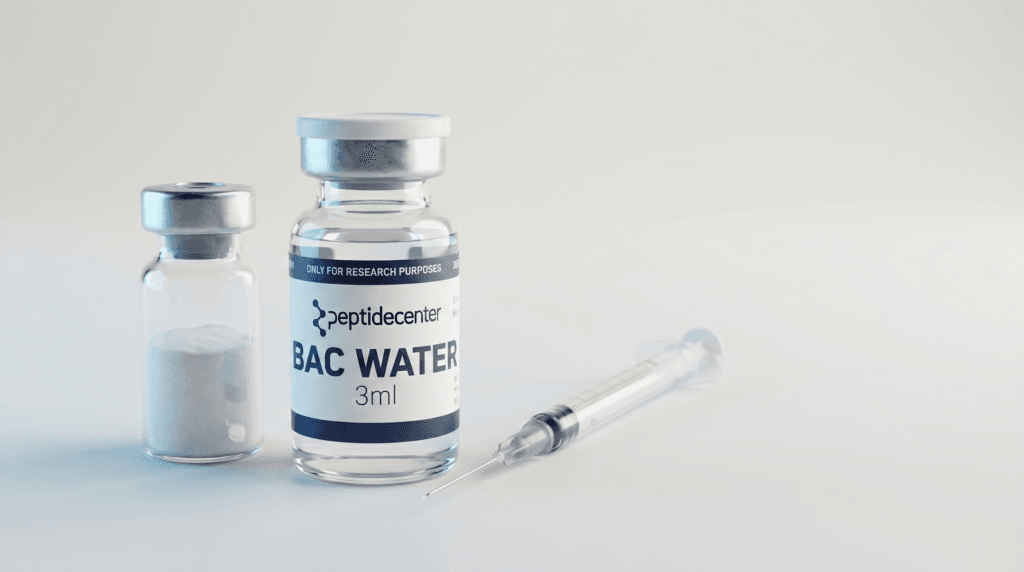
Freeze-dried peptides are supplied as a fine powder in a sealed vial. Before you can work with them in the lab, this powder must be dissolved in a suitable liquid — a process that reconstitution hot. Dissolving peptides is a simple operation in itself, but how carefully you do it directly determines the quality and shelf life of the end result.
In this guide, you will read exactly how to dissolve peptides: which liquid to use, how to correctly reconstitute the powder, how to calculate the concentration, which errors to avoid, and how to store a dissolved peptide without loss of integrity. All information is technical in nature and intended solely for laboratory and research purposes.
Important: This information describes the dissolution and storage of research compounds as a laboratory procedure. It does not constitute instructions for use or administration. Research peptides are not approved for human consumption in the Netherlands or the EU.
Why peptides are supplied freeze-dried
Peptides are chains of amino acids and are naturally fragile molecules. In dissolved form, they are susceptible to degradation by moisture, oxygen, heat, and bacterial contamination. To keep them stable during transport and storage, they are lyophilized — or freeze-dried.
During lyophilization, all water is extracted from the peptide, leaving a dry, stable powder. In this form, a peptide remains shelf-stable for much longer and can withstand normal shipping conditions. This is precisely why freeze-dried peptides can be shipped without refrigeration: the dry powder is stable for weeks at room temperature and survives standard shipping without loss of quality.
As soon as liquid is added, that changes. The amino acid chain comes into contact with water and the clock starts ticking — that is why the way you dissolve freeze-dried peptides is so crucial.
Which liquid do you use?
The default choice for reconstitution is bacteriostatic water — also known in the research community bac water mentioned. This is sterile water with the addition of 0.9% benzyl alcohol, a preservative that inhibits the growth of bacteria.
Een uitgebreide vergelijking, inclusief houdbaarheid na openen en waar je het wel en niet koopt, staat in BAC water vs steriel water.
The difference compared to ordinary sterile water is functionally decisive:
- Bacteriostatic water (bac water) — contains 0.9% benzyl alcohol. The preservative inhibits microbial growth, ensuring that a dissolved peptide remains usable for several weeks, even from a bottle that is drawn from multiple times.
- Sterile water — contains no preservative. Once the bottle is opened, contamination can occur within hours to days. Suitable for single use only.
Bacteriostatic water is the right choice for virtually all water-soluble research peptides. At 0.9%, the preservative has a negligible effect on most peptides and is the reason why an opened bottle remains usable for a longer period.
At PeptideCenter, bacteriostatic water is included as standard with every vial, so you can get started right away. If you need extra, then Bacteriostatic water available separately in the shop.
For some difficult-to-dissolve peptides, alternative solvents are used, such as a diluted acetic acid solution. However, this is the exception, not the rule — bacteriostatic water covers the vast majority of cases.
Step by step: dissolving peptides
Dissolving peptides is a simple procedure, provided it is performed carefully. Sterility and calm are the two keywords.
1. Let everything come to room temperature. Remove the freeze-dried bottle and the bacteriostatic water from the refrigerator and allow both to reach room temperature. A large temperature difference can cause condensation.
2. Disinfect the rubber caps. Wipe the rubber stopper of both the peptide bottle and the water bottle clean with an alcohol wipe. Let dry.
3. Draw up the desired amount of water. Determine in advance how much liquid you want to use to dissolve the powder (see the calculation section below). Draw up this amount of bacteriostatic water.
4. Add the water slowly. This is the most important step. Insert the needle into the peptide vial and let the water along the inside wall of the bottle walk downwards — never apply force directly to the powder. A direct stream can damage the fragile amino acid chain.
5. Allow to dissolve, do not shake. Gently swirl the bottle or simply let it stand until the powder is completely dissolved. Never shake. Vigorous shaking can damage the peptide structure. A correctly dissolved peptide yields a clear, colorless liquid.
If the solution is cloudy, discolored, or contains visible particles, something has gone wrong and the material is no longer reliable.
Calculate concentration
You determine the concentration of your dissolved peptide yourself via the amount of water you add. The formula is simple:
Amount of peptide (mg) ÷ volume of water (mL) = concentration (mg/mL)
A few calculation examples make it concrete:
| Peptide in a bottle | Added water | Resulting concentration |
|---|---|---|
| 10 mg | 1 mL | 10 mg/mL |
| 10 mg | 2 mL | 5 mg/mL |
| 5 mg | 1 mL | 5 mg/mL |
| 5 mg | 2 mL | 2.5 mg/mL |
The amount of water you choose does not change the total amount of peptide — only the concentration per milliliter. More water means a lower concentration in a larger volume; less water means a higher concentration in a smaller volume. Which concentration is most convenient depends on your research design.
A handy rule of thumb: the higher the concentration, the smaller the volumes you work with. Many researchers therefore choose a concentration that is easy to measure with the measuring instruments they use.
Common mistakes when solving
Most problems in peptide resolution can be traced back to a handful of avoidable errors. Those who know these keep the quality of the compound intact:
- Spray the water forcefully onto the powder. The direct stream damages the amino acid chain. Always let the water run along the inner wall.
- Shake to speed up dissolving. Vigorous shaking damages the peptide structure. Swirling or letting it stand is the correct method.
- Just use sterile water instead of bacteriostatic water. Without a preservative, contamination occurs quickly and the bottle is only usable for a short time.
- Freezing a dissolved peptide. The freeze-thaw cycle forms ice crystals that damage the chain. Dissolved belongs in the refrigerator, not the freezer.
- Working with non-sanitized caps. Contamination through non-sterile working is one of the fastest ways to render a compound unusable.
- Ignoring a large temperature difference. Cold bottle, warm water: condensation is a risk. Let everything come to room temperature first.
- Exceeding the 28-day period. After approximately four weeks, protection against microbial growth decreases. Keep track of the reconstitution date.
Storage and shelf life
Once a peptide is dissolved, different storage rules apply than for the dry powder. The overview:
| Form | Storage temperature | Shelf life |
|---|---|---|
| Freeze-dried, unopened | 2-8°C (refrigerator) | 12-24 months |
| Freeze-dried, long-lasting | -20°C (freezer) | 2+ years |
| Dissolved (bacteriostatic water) | 2-8°C (refrigerator) | ~28 days |
A few principles that determine shelf life:
Dissolved peptides belong in the refrigerator, not in the freezer. This is essential for a dissolved peptide. A freeze-thaw cycle forms ice crystals that damage the amino acid chain and reduce quality. Therefore, always store a dissolved bottle refrigerated at 2-8°C, never frozen.
The 28-day rule. The bacteriostatic effect of benzyl alcohol lasts for approximately 28 days. After that, protection against microbial growth decreases and the risk of contamination increases. This is the same timeframe that applies to multi-dose vials in clinical settings. Some peptides have a slightly wider window of four to six weeks, but 28 days is the safe standard.
Avoid the four enemies. The four factors that degrade peptides most rapidly are: temperature fluctuations, light and UV exposure, repeated freeze-thaw cycles, and contamination from non-sterile handling. Therefore, store vials in the main compartment of the refrigerator (not in the door, where the temperature fluctuates), out of direct light, and always use clean caps.
Storage tips per situation
- Will you be using a peptide within a few months? Then the refrigerator (2-8°C) is sufficient for the freeze-dried bottle.
- Are you saving for a longer period? Freeze the unopened, freeze-dried bottle at -20°C. Avoid repeatedly moving it back and forth between the freezer and room temperature — the condensation that forms is harmful.
- Once solved? Always refrigerated, never frozen, and use within approximately 28 days.
Quality starts at the source
A careful reconstitution protocol only holds up if the starting material is sound. A peptide that has already been contaminated during production or transport is compromised even before you open the vial. Therefore, the purity and origin of the compound are the foundation of every storage protocol.
PeptideCenter's peptides are of Swiss production and are supplied with a controlled purity of over 99.2%. Freeze-dried, sealed, and ready for reconstitution according to the protocol in this guide — including the bacteriostatic water required for this.
Frequently Asked Questions
What is peptide reconstitution? Reconstitution is the dissolution of a freeze-dried (lyophilized) peptide powder in a liquid, usually bacteriostatic water. This creates a liquid solution that can be worked with in the laboratory.
Which water do you use to dissolve peptides? Bacteriostatic water — also known as bac water — is the standard. This is sterile water with 0.9% benzyl alcohol as a preservative, which inhibits microbial growth and keeps a dissolved peptide usable for several weeks. Ordinary sterile water contains no preservative and is only suitable for single use.
How do you calculate the concentration? Divide the amount of peptide (in mg) by the volume of added water (in mL). For example: 10 mg of peptide dissolved in 2 mL of water gives a concentration of 5 mg/mL.
How long does a dissolved peptide remain viable? Dissolved in bacteriostatic water and stored refrigerated at 2-8°C, a peptide remains usable for approximately 28 days. Some peptides have a slightly longer window, but 28 days is the safe standard.
Can you freeze a dissolved peptide? No. A freeze-thaw cycle forms ice crystals that damage the amino acid chain. Dissolved peptides should be kept refrigerated in the refrigerator (2-8°C), not in the freezer.
Why shouldn't you shake a peptide? Vigorous shaking can damage the fragile peptide structure. Swirl the bottle gently or let it stand until the powder has dissolved.
How long does freeze-dried powder last? Unopened and refrigerated at 2-8°C, freeze-dried powder remains stable for 12-24 months. Frozen at -20°C, this is 2 years or longer.
Delving deeper into research peptides
Discover product specifications, background articles, and relevant categories within the PeptideCenter knowledge base.