






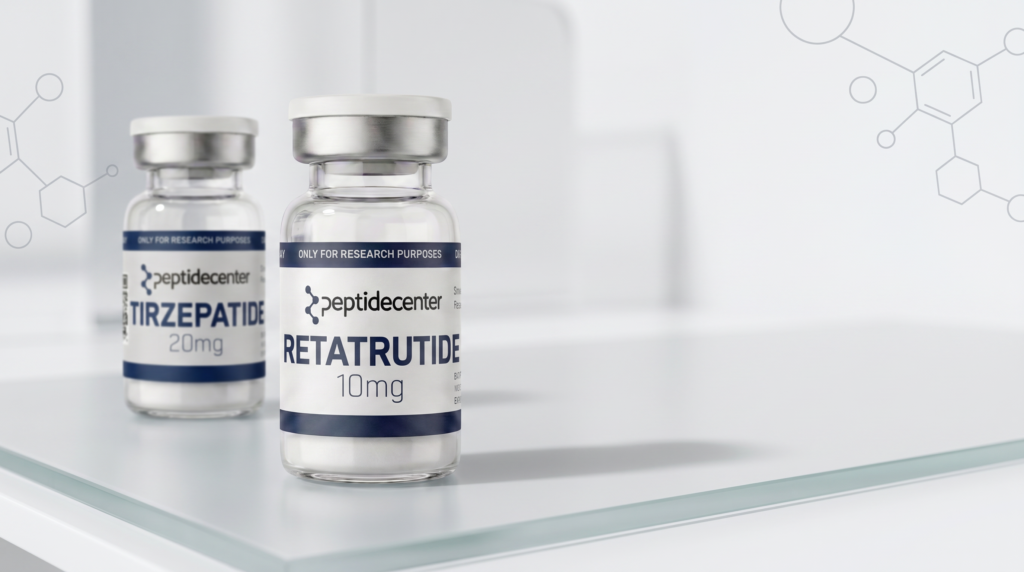
Retatrutide is described in scientific circles as the most advanced GLP-1 receptor agonist developed to date. Whereas Semaglutide activates one hormone receptor and Tirzepatide two, Retatrutide acts on three receptors at the same timeIn Phase 2 studies, this led to an average weight loss of 24.2% at the highest dosage after 48 weeks — a result that far exceeds the effectiveness of existing medication.
In this article, you will read exactly what Retatrutide is, how it works, what the research shows, and how it differs from other GLP-1 peptides such as Tirzepatide and Semaglutide.
Important: Retatrutide is a research compound. All information in this article is intended for educational and scientific purposes. The product is not approved for human consumption in the Netherlands or the EU.
What is Retatrutide?
Retatrutide (also known by the code LY3437943) is an experimental peptide developed by pharmaceutical company Eli Lilly. The drug is currently in Phase 3 clinical trials under the name TRIUMPH-program and is considered the successor of Tirzepatide (Mounjaro/Zepbound).
The distinguishing feature of Retatrutide is that it is a triple-agonist is: it simultaneously activates three different hormonal receptors involved in the regulation of appetite, blood sugar, and energy expenditure:
- GLP-1 receptor (glucagon-like peptide-1)
- GIP receptor (glucose-dependent insulinotropic polypeptide)
- Glucagon receptor
This triple action is unique. Existing agents such as Semaglutide (Ozempic, Wegovy) target exclusively the GLP-1 receptor. Tirzepatide (Mounjaro, Zepbound) combines GLP-1 and GIP. Retatrutide adds the glucagon receptor to this—an approach that leads to a significantly stronger effect on fat burning and energy expenditure in preclinical research.
How does Retatrutide work?
The action of Retatrutide is based on the synergy between three complementary mechanisms. Each mechanism has a specific function in metabolism:
1. GLP-1 activation: appetite suppression and satiety
The GLP-1 receptor is responsible for the feeling of satiety after a meal. Activation of this receptor:
- Slows down the gastric emptying, which keeps you feeling full longer
- Suppresses it feeling of hunger in the hypothalamus (brain)
- Stimulates insulin release at elevated blood sugar levels
This is the same mechanism that Semaglutide uses and is responsible for the well-known “no hunger” experience in Ozempic users.
2. GIP activation: improved fat metabolism
The GIP receptor plays a role in fat uptake and the sensitivity of adipose tissue to insulin. Activation:
- Improves the insulin sensitivity in fatty tissue
- Supports the fat burning instead of fat storage
- Enhances the weight loss effect of GLP-1
Tirzepatide combines these two receptors, which explains why Tirzepatide consistently performs better than Semaglutide for weight loss in clinical studies.
3. Glucagon activation: increased energy expenditure
This is where Retatrutide really distinguishes itself. Activation of the glucagon receptor:
- Increases it basal energy consumption (burn more calories at rest)
- Stimulates the lipolysis (breakdown of fat tissue) in the liver
- Improves fat metabolism at the cellular level
With this triple approach, not only is less eaten, but the body is also actively stimulated to burn more energy. The result: significantly higher weight loss than with single or dual agonists.
Retatrutide vs Tirzepatide vs Semaglutide
To make the distinction between these three products concrete, below is a direct comparison of the most important properties:
| Characteristic | Retatrutide | Tirzepatide | Semaglutide |
|---|---|---|---|
| Type agonist | Triple (GLP-1, GIP, glucagon) | Dual (GLP-1, GIP) | Single (GLP-1) |
| Developer | Eli Lilly | Eli Lilly | Novo Nordisk |
| Brand name (medical) | Not yet | Mounjaro / Zepbound | Ozempic / Wego |
| Research phase | Phase 3 (TRIUMPH) | FDA approved | FDA approved |
| Weight loss (48 wk, highest dose) | ~24,2% | ~20,9% | ~14,9% |
| Frequency of administration | Weekly (subcutaneous) | Weekly (subcutaneous) | Weekly (subcutaneous) |
| Effect on energy consumption | Increased | Neutral | Neutral |
| Market availability NL | Research only | On prescription from doctor | On prescription from doctor |
The figures speak for themselves. Retatrutide surpasses Tirzepatide by a difference of approximately 3-4 percentage points in weight loss, and Semaglutide by nearly 10 percentage points. That is a significant difference for people struggling with significant overweight.
Why Retatrutide performs better
The difference in effectiveness is mainly due to the glucagon component. While GLP-1 and GIP work primarily through appetite suppression and insulin sensitivity, glucagon activates the active energy consumptionThis means that users not only eat less, but also burn more calories — a combination that metabolism cannot bypass.
What does the research say?
The most important data on Retatrutide comes from the phase 2 study which was published in June 2023 in The New England Journal of MedicineThis study examined 338 obese adults (BMI ≥30) for 48 weeks, with different dosages:
- 1 mg: average 8.7% weight loss
- 4 mg: average 17.1% weight loss
- 8 mg: average 22.8% weight loss
- 12 mg: average 24.2% weight loss
For comparison: the placebo group lost an average of 2.1% of their starting weight. This makes Retatrutide statistically and clinically one of the most effective weight-reducing agents ever studied.
Additional health benefits
In addition to weight loss, the study also showed improvement in other metabolic markers:
- HbA1c ranging (long-term blood sugar level)
- Lowered blood pressure
- Improved cholesterol profile
- Reduced fatty liver
These effects are comparable to, or slightly stronger than, those of Tirzepatide and Semaglutide.
Side effects
The side effects are largely similar to those of other GLP-1 agents. The most common are:
- Nausea (especially in the build-up phase)
- Vomiting and diarrhea
- Reduced appetite (intended effect, but can go too far)
- Fatigue
- Blockage
In the study, approximately 6-16% of participants discontinued due to side effects — this percentage increases at higher dosages. Most side effects are mild to moderate and disappear after a few weeks, provided the dosage is increased gradually.
Repatriation in the Netherlands: the status in 2026
Retatrutide is at this moment not available for human consumption in the Netherlands or the rest of the EU. The product is in phase 3 clinical trials. It is expected that:
- Phase 3 results (TRIUMPH program) will become available during 2026-2027
- If the results are positive, an EMA (European Medicines Agency) application will follow.
- Approval in the EU is not expected before 2028.
- Reimbursement via health insurers remains uncertain after that.
For research purposes Retatrutide is available through specialized suppliers. Researchers, laboratories, and biohackers use the drug to study its action and effects under controlled conditions.
Quality control is essential
Because Retatrutide is only available as a research compound, the quality depends heavily on the supplier. Important points to consider when evaluating a provider:
- Purity: at least 99% (preferably tested via HPLC)
- Origin: transparency regarding production location
- Batch information: every batch must be traceable and testable
- Packaging: freeze-dried powder in sealed vials
Bee PeptideCenter We supply exclusively Retatrutide with a purity above 99.7%, sourced from Swiss production facilities. Every batch is HPLC tested, and the results are available upon request.
Frequently asked questions about Retatrutide
What is the difference between Retatrutide and Tirzepatide?
Retatrutide activates three hormone receptors (GLP-1, GIP, glucagon), while Tirzepatide activates only two (GLP-1 and GIP). The addition of glucagon activation in Retatrutide results in increased energy expenditure, leading to greater weight loss in clinical studies.
Is Retatrutide safe?
The safety of Retatrutide is currently being investigated in Phase 3 studies. Phase 2 data show an acceptable safety profile, comparable to other GLP-1 agents. Long-term effects are not yet fully known.
Can I get Retatrutide through my GP?
No. Retatrutide has not yet been approved by the EMA and is not available through regular pharmacies or general practitioners in the Netherlands. The drug is currently only available within clinical studies or as a research compound.
What is the dosage of Retatrutide?
In clinical studies, dosages of 1 mg, 2 mg, 4 mg, 8 mg, and 12 mg per week have been tested. The optimal dosage depends on the goal and the individual response. For research purposes, comparable dosages are maintained.
How does Retatrutide relate to Ozempic?
Ozempic contains Semaglutide, a single GLP-1 agonist. Retatrutide acts on three receptors simultaneously and shows significantly stronger effects on weight loss in studies (24.2% vs ~14.9% with Semaglutide).
When will Retatrutide be available in the Netherlands?
It is expected that Retatrutide will receive EU approval around 2028 at the earliest, subject to positive Phase 3 results. Availability through pharmacies and health insurers will follow thereafter.
What is the TRIUMPH research program?
TRIUMPH is the name of Eli Lilly's Phase 3 clinical trial program in which Retatrutide is being tested for obesity, type 2 diabetes, and related metabolic disorders. Multiple sub-studies are running in parallel.
Want to know more about research peptides?
Retatrutide is one of the most promising developments in metabolic medicine. For researchers and biohackers who want to keep up with the latest scientific developments, access to reliable information and high-quality compounds is essential.
Do you want to stay informed? of new batch releases, scientific updates, and comparative studies? Subscribe to our newsletter and receive a selection of the most important updates from the peptide research world once a week.
Sources and further reading:
- Jastreboff AM, et al. Triple-Hormone-Receptor Agonist Retatrutide for Obesity — A Phase 2 Trial. New England Journal of Medicine, 2023.
- PubMed: Retatrutide phase 2 study, published in The New England Journal of Medicine.
- ClinicalTrials.gov: Retatrutide phase 3 study within the TRIUMPH program.
- Eli Lilly: TRIUMPH-1 phase 3 results for Retatrutide, 2026.
- Abdul-Rahman O, et al. Retatrutide: A comprehensive review of a novel triple agonist. European Journal of Pharmacology, 2024.
Further exploration within the GLP-1 collection
Compare Retatrutide, Tirzepatide, and Semaglutide within the same collection. Carefully selected for research purposes.